

The Holy Maundy Thursday
UOJ continues the publication of a series of facts about the spiritual significance of each day of Great and Holy Week
On Great and Holy Thursday, which is also known as Maundy Thursday in the German-speaking world (the name derives from the Middle High German word "grînen" or "greinen," meaning "to weep" or "to lament." It has nothing to do with the color green), we commemorate the institution of the Holy Eucharist and the priesthood.
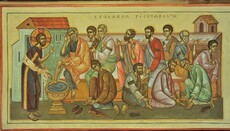
Already on the eve, in the Matins of Great and Holy Thursday in the cathedrals, the rite of the washing of feet is performed. CHRIST Himself washed the feet of His disciples - He who stands above all proved Himself to be a servant of His own band of disciples by washing their feet. CHRIST thus gave us an example of Christian humility and self-denial.
In the morning, Vespers is celebrated with the Liturgy of St. Basil. We hear the following readings from the Old Testament: Ex 19:10–19; Job 38:1–12; 42:1–5 and Is 50:4–11. As the Apostolic reading we hear 1 Cor 11:23–32. And the following Gospel pericopes: Mt 26:2–20; Jn 13:3–17; Mt 26:21–39; Lk 22:43–45 and Mt 26:40–75. 27:1–2.
Instead of the Cherubikon, the Communion hymn and the "We have seen the true light," the following hymn in the 6th tone is sung: At Your mystical supper, Son of God, receive me today as a guest. Never will I reveal the mystery to Your enemies, nor will I give You a kiss like Judas, but like the thief I confess to You: Remember me, Lord, in Your Kingdom!
We know this hymn from the preparatory prayers for Communion from the Divine Liturgy.
In the evening, Matins of Great and Holy Friday is celebrated. The core of this service consists of the "Akolouthia of the Holy and Saving Passion of our Lord and Savior Jesus Christ," whose essence is the reading of the 12 Passion Gospels with the chanted antiphons interspersed between them. This Akolouthia has a very venerable age. It reaches back to the ancient church station services at the various stations of the Savior's Passion in Jerusalem, which the Gallo-Roman pilgrim Aetheria already describes to us in her pilgrimage account from the late 4th century.
The last troparion of the service already formulates everything heard as good news: "You have redeemed us from the curse of the law through Your precious blood. Nailed to the cross, pierced by the lance, You caused immortality to spring forth for mankind. Our Savior, glory be to You!"